
Working in Waters
The Bureau of Water Pollution Control (BWPC) protects waters of the State from the discharge of pollutants. BWPC issues temporary permits in accordance with Chapter 445A of the Nevada Revised Statutes.
Who needs permit coverage
The Temporary Working in Waters permit is required before operating earthmoving equipment in or around surface waters, waterbodies, and any water conveyance feature of the State even if they are dry. Temporary Working in Waters permits are for work that will last 180 days or less. This permit does not authorize discharges of any kind.
Temporary Working in Waters permits will typically only be issued twice for one project (total of 1 year). Reissuances are given on a case-by-case basis. Projects expected to take longer than 1 year must generally apply for an Individual discharge permit. Contact the BWPC if you are unsure about which permit would be best for your specific project.
What is a water of the State
Waters of the State are defined in NRS 445A.415 as all waters situated wholly or partly within or bordering upon the State of Nevada. This includes but is not limited to:
|
|
|
|
|
|
|
|
|
|
|
|
What is considered heavy equipment
Heavy equipment is generally considered heavy-duty vevicles that are specifically designed to assist with construction tasks such as backhoes, wheel loaders, skid steers, scrapers, drill rigs, cranes, trenches, graders, all terrain forklifts, bulldozers, pavers, excavators, etc.
Does my project require a permit
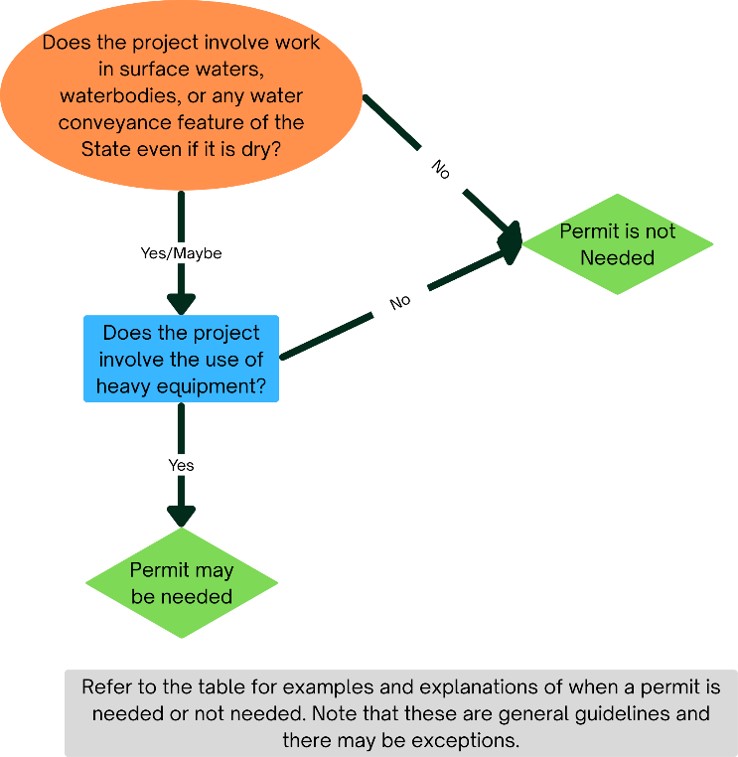
| Project | Permit Needed | Permit Not Needed | Comment |
|---|---|---|---|
| Working with heavy equipment in a river, stream, creeek, lake, reservoir, wetland, marsh, slough, wash, spring, or pond in Nevada. | X | Golf course ponds being filled in is an exception to this. | |
| Working without heavy equipment (i.e. hand tools) in a river, stream, creek, lake, reservoir, wetland, marsh, slough, wash, springs, or pond in Nevada | X | ||
| Installing a culvert or channel crossing using heavy equipment | X | ||
| Repairing or installing curb and gutter | X | ||
| Creating a stormwater channel that did not previously exist | X | ||
| Connecting a stormwater channel that did not previously exist to a waters of the State using heavy equipment | X | ||
| Boring horizontally underneath the surface waters, waterbodies, and water conveyance features | X | ||
| Geotechnical boring in a waterway | X | ||
| Removing debris from a waterway using heavy equipment | X | ||
| Removing debris from a wateway without heavy equipment (i.e. hand tools) | X | ||
| Work occuring with heavy equipment over a waterway in which there is construction under the bridge or they are drilling through a bridge | X | ||
| Work occuring with heavy equipment on a bridge that is not under the bridge or drilling through it | X | ||
| Playas: if the work is in the water | X | ||
| Playas: if the work is not in the water, there is no downstream connectivity to another waterbody, and there is not an aquatic species dependent upon it | X | ||
| Dry lakes: if the work is not in the water. If there is also downstream connectivity to another waterbody and/or there is an aquatic species dependent on it | X | ||
| Dry lakes: if the work is not in the water, there is no downstream connectivity to another waterbody, and there is not an aquatic species dependant upon it | X | ||
| Detention basins (temporarily stores water) | X | In general if these are dry, they do not need a permit. When there is water in the basins, this will be examined case by case. | |
| Retention basins (ponds and infiltrates water) | X | ||
| Waterways to a detention basin | X | ||
| Waterways to a retention basin | X | ||
| Existing stormdrain systems | X | If the work is in the stormdrain system and there will be replacements or connections to culverts a permit may be needed. | |
| Restoration work using heavy equipment | X | ||
| Installing/extending a pier using heavy equipment even if the work is done via a barge and the heavy equipment is on the barge. | X | Installing floating docks outside of Lake Tahoe would not need a permit. | |
| Installing a buoy and fish habitat using a barge | X | ||
| Installing a buoy and fish habitat using using diver teams | X | ||
| Irrigation ditches with return flows | X | ||
| Irrigation ditches without return flows | X |
How to apply for permit coverage
You must complete the following two steps to get coverage:
- Complete a Notice of Intent (permit application) online in the General Permits System. There you can also:
- Check the Status of your permit
- View the project contact information for your permit.
For help with the Notice of Intent online application, please see the guidance documents and checklist:
- Visit the General Permits Online Application
- Download Applying for a Working in Waters Permit
- Download Checklist for completing a Working in Waters Application
- Submit the filing fee and the signed Notice of Intent. To sign the Notice of Intent you must be:
- a principal executive office of the corporation;
- a general partner of the partnership;
- the proprietor of a sole proprietorship;
- a principal executive officer, ranking elected official or authorized employee of the municipal, state, or other public facility; or
- a duly authorized representative that has an authorization letter on file with the Bureau of Water Pollution Control. A duly authorized representative letter must br in writing by a person described in a-d above and must specify the authorization for either an individual or a position within the organization.
If you do not receive a permit from BWPC, you cannot start work.
How to pay the application fee
The application fee may be paid electronically on the e-payments page or by mailing in a check. For either method, include your site ID number with your payment
Mail checks to:
Nevada Division of Environmental Protection
Bureau of Water Pollution Control
901 South Stewart Street, Suite 4001
Carson City NV 89701
The application fee is: $350.
What reporting must I complete
A water quality logbook (logbook) must be maintained onsite for the duration of the project. The logbook shall include monitoring results (water quality sampling, BMP, visual inspections, and vehicle inspections), time and date, pertinent notes on specific project activities, and what was done to address any turbidity exceedances.
Discharge Monitoring Report (DMR) Forms must be submitted to the Division by the 28th day of each month of the permit. The DMR will include analytical data and monitoring results and must be signed by the authorized representative that is responsible for the work covered by the permit.
| Electronic Submittal | Mail Submittal |
|---|---|
An original signed copy of the report can be mailed to: | An original copy can be submitted to the Division's Carson City office at: |
When do I submit my final report
The final narrative report must include:
- Photos describing and documenting the results of the projects activities before, after, and during the project.
- Project logbook
The final narrative report must be submitted on or before the 28th day of the month following the expiration of the permit or by the 28th day of the month following the project completion, whichever comes first.
| Electronic Submittal | Mail Submittal |
|---|---|
An original signed copy of the report can be mailed to: | An original copy can be submitted to the Division's Carson City office at: |
How to terminate coverage
The Working in Waters permit will automatically expire after 180 days from the effective date.
Do I need a Working in Waters permit or coverage under the Construction Stormwater Permit
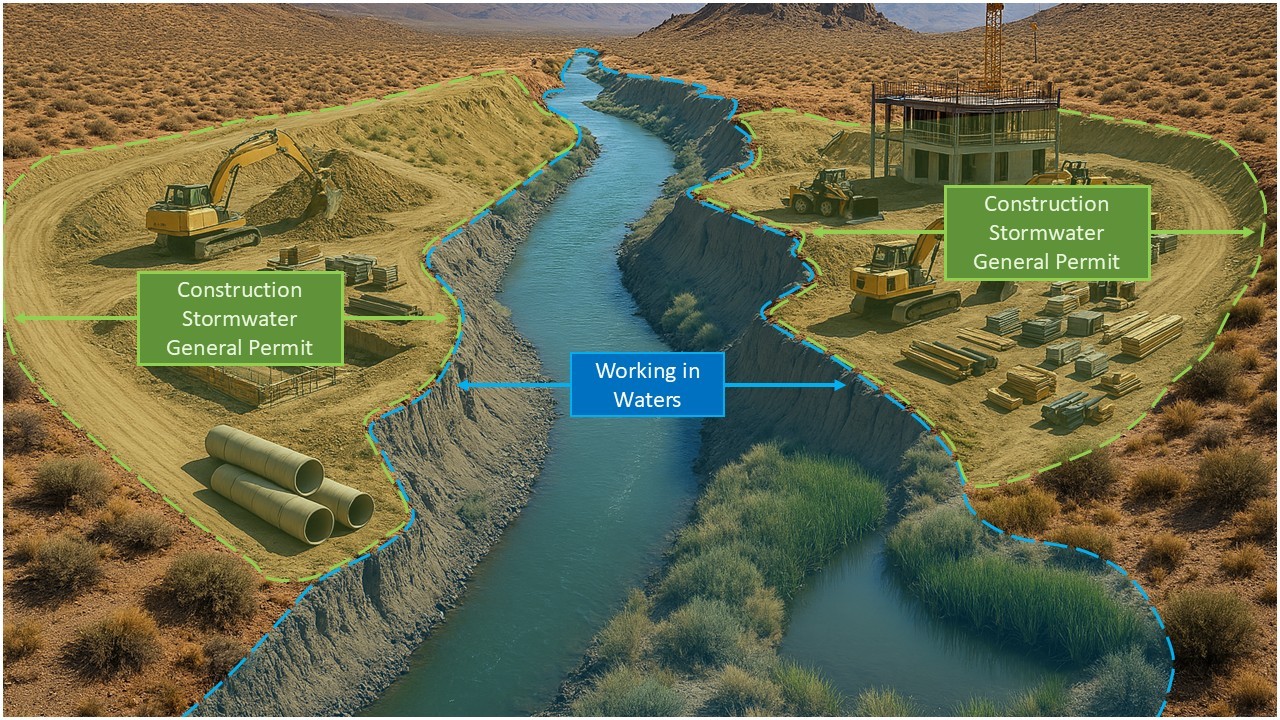
As Shown in the Photo 1, a Working in Waters Permit is required for any work conducted within the banks of a water of the State. Projects that meet the criteria for Construction Stormwater General Permit coverage require authorization from the tops of the banks outward. Projects that involve both in-channel work and adjacent land disturbance, such as bridge replacements or stream crossing improvements, may require both permits.
What other permits will I need from the Bureau of Water Pollution Control
- If you have a contrustion site or a restoration project, you may need additional permitting. Please contact the BWPC for more information, see our additional permitting webpages, and refer to our Construction Project Permitting Flowchart document below. This flowchart is designed to provide general guidance and is not intended to cover every situation. It is the owner/operator's responsibility to contact all required agencies and entities regarding required permitting.
- Download the Construction Project Permitting Flowchart
NDEP resources
- Visit the List of Nevada Certified Labs
- Visit the Online Spill Report
Not finding what you are looking for?
- Contact the Bureau of Water Pollution Control for assistance
- Visit the Bureau of Water Pollution Control Contacts