Sustainable Materials Management (SMM)
The overarching goal of any sustainable practice is to ensure that people have sufficient resources to meet today’s needs as well as the needs of the future. The SMM framework helps to achieve this goal by focusing on ways to use materials in the most productive way and by emphasizing waste reduction.
The SMM framework views waste as a system inefficiency, and for the wastes that cannot be avoided, this approach looks for ways to use those wastes as resources and inputs to new processes. Thus, SMM promotes a circular system with a focus on reducing negative impacts to the environment and public health by reducing waste, reusing materials, recycling, and composting. Landfilling is viewed as a last resort.
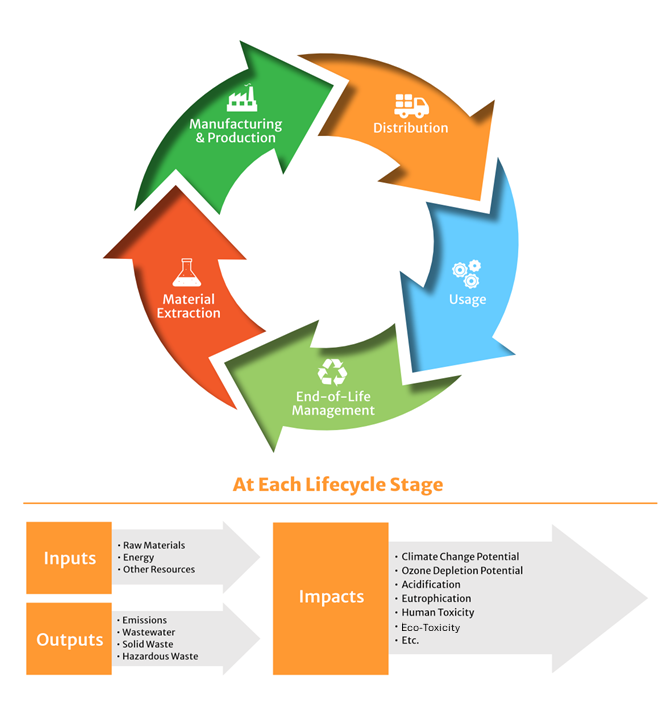
Additionally, rather than focusing solely on end-of-life management, the SMM framework takes a step back and looks at whole systems and lifecycles of materials. SMM involves understanding material flows and the associated inputs (e.g., raw materials, energy, water) and outputs (e.g., waste streams, emissions, by-products) at each stage of a product’s lifecycle. Viewing products and materials through this lifecycle perspective helps us understand that when a product ends up in a landfill, more impacts are occurring than just the disposal of that particular item. When a product is thrown away without making the most productive use of it, all of the upstream inputs are lost, and the associated environmental impacts are intensified.